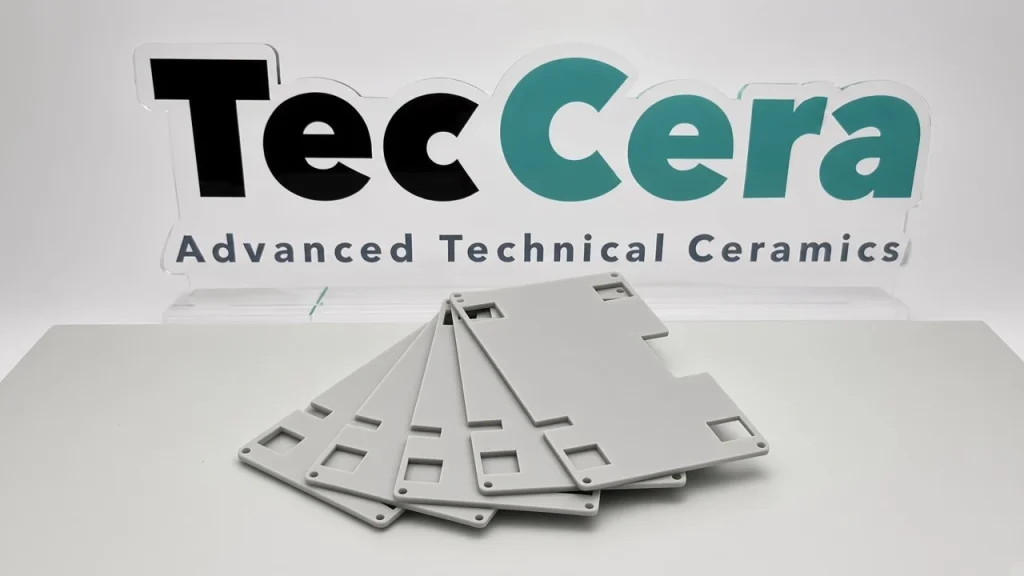
Aluminum Nitride Ceramics
Aluminum Nitride (AlN) Ceramic Plates and Substrates
High-thermal-conductivity aluminum nitride ceramic plates and substrates for power electronics, semiconductor packaging, electrical insulation, and advanced thermal management.
Detailed Product Information
Typical Material Properties
|
Parameter |
Typical Value |
|
AlN Content |
≥99.5% available; grade-dependent |
|
Oxygen Content |
≤1.0% for specified high-conductivity grades |
|
Thermal Conductivity at Room Temperature |
170–200 W/(m·K) for specified grade |
|
Coefficient of Thermal Expansion, 20–300°C |
Approximately 4.5 × 10⁻⁶/K |
|
Volume Resistivity |
≥10¹³ Ω·cm |
|
Dielectric Constant at 1 MHz |
8.5–9.0 |
|
Flexural Strength |
≥300 MPa |
|
Substrate Surface Roughness |
Ra ≤0.3 μm |
|
Surface Finish |
As-fired, ground, lapped, or polished |
|
Dimensions and Tolerances |
Customized according to drawing |
These values represent a selected high-thermal-conductivity AlN grade rather than every aluminum nitride ceramic. Final properties must be confirmed according to material grade, thickness, manufacturing process, surface finish, and test method.
Aluminum Nitride (AlN) Ceramic Plates and Substrates
TecCera supplies aluminum nitride ceramic plates and substrates for high-power electronics, semiconductor packaging, thermal management, and electrically insulating heat-dissipation applications.
Aluminum nitride combines high thermal conductivity with excellent electrical insulation and a coefficient of thermal expansion relatively close to semiconductor materials. Compared with conventional alumina substrates, selected high-conductivity AlN grades provide substantially improved heat dissipation while maintaining electrical isolation.
Standard and custom sizes, thicknesses, holes, slots, profiles, tolerances, and surface finishes are available according to customer drawings.
Key Features
- High thermal conductivity for efficient heat dissipation
- Excellent electrical insulation
- Coefficient of thermal expansion suitable for semiconductor packaging
- Good mechanical strength and dimensional stability
- Lower dielectric constant than many alumina grades
- Precision-ground, lapped, and polished surfaces available
- Custom holes, slots, steps, and profiles available
- Metallization and copper-clad options subject to technical confirmation
Typical Applications
Power Electronics
- IGBT and MOSFET power modules
- EV inverter and converter modules
- High-power transistor substrates
- Electrically insulating heat spreaders
- Power-module packaging components
LEDs and Semiconductor Lasers
- High-power LED substrates
- Laser-diode submounts
- Optical-device heat spreaders
- Thermally conductive insulating supports
Semiconductor and Electronic Equipment
- IC packaging substrates
- RF and microwave-device substrates
- Semiconductor-equipment components
- Insulating plates requiring rapid heat transfer
- GaN-device carriers and thermal-management components
Sintered AlN ceramic substrates should not be described as GaN or AlGaN epitaxial-growth wafers unless the supplied material is specifically manufactured and qualified for epitaxial growth.
Available Product Options
- Bare AlN ceramic plates
- Precision AlN substrates
- Polished AlN substrates
- Metallized AlN substrates
- AlN heat spreaders
- Custom-machined AlN components
- DBC or AMB copper-clad AlN substrates, subject to manufacturing capability
Frequently Asked Questions
1. Which provides better heat dissipation: AlN or alumina?
Selected AlN grades typically provide much higher thermal conductivity than alumina while maintaining electrical insulation. This makes AlN more suitable for high-power electronic devices where heat must be transferred efficiently through an electrically insulating substrate.
The actual advantage depends on material grade, substrate thickness, interface quality, metallization, and assembly design.
2. What is the maximum operating temperature of aluminum nitride?
There is no universal maximum temperature for every AlN plate. Performance depends strongly on atmosphere, material grade, mechanical load, impurities, and required service life.
AlN can oxidize in air at elevated temperatures. Higher-temperature operation may require controlled atmospheres and application-specific validation. Do not use 1500°C as a guaranteed continuous operating temperature without supporting material data.
3. Is aluminum nitride safer than beryllium oxide?
Aluminum nitride does not contain beryllium and therefore avoids beryllium-specific exposure concerns associated with BeO dust generated during machining or damage.
However, AlN powder and machining dust must still be handled using appropriate industrial-hygiene controls. “Beryllium-free” is more accurate than describing the material as completely non-toxic.
4. Can aluminum nitride plates and substrates be customized?
Yes. Customization options include:
- Length, width, and thickness
- Holes, slots, steps, and special profiles
- Dimensional and geometric tolerances
- Precision grinding, lapping, and polishing
- Surface-roughness requirements
- Metallization and copper-clad structures, when available
Please provide a technical drawing, thermal-conductivity requirement, electrical requirements, surface finish, operating conditions, and order quantity for technical review and quotation.
Contact TecCera for custom aluminum nitride ceramic plates, substrates, material selection, samples, and quotation.