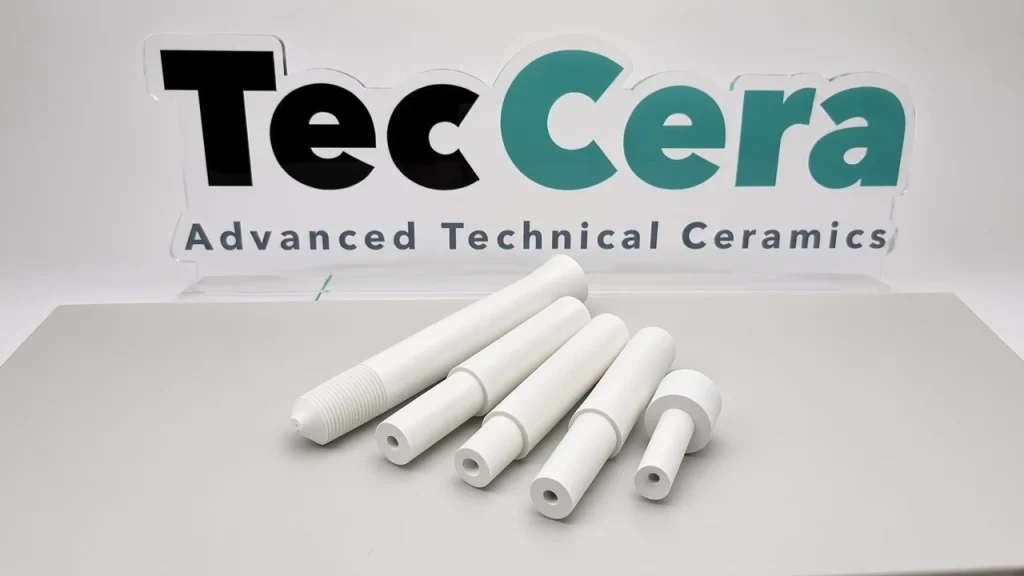
Boron Nitride Ceramics
Hot-Pressed Boron Nitride Ceramic Parts
Custom hot-pressed boron nitride ceramic parts offering excellent machinability, electrical insulation, thermal-shock resistance, and high-temperature performance for vacuum, electronic, and molten-metal applications.
Detailed Product Information
Typical Technical Properties
|
Parameter |
Typical Value |
|
Material |
Hot-pressed hexagonal boron nitride |
|
Abbreviation |
HPBN / hBN |
|
Color |
White or ivory |
|
Density |
1.9–2.2 g/cm³ |
|
Thermal conductivity |
Approximately 40–50 W/(m·K) |
|
Coefficient of thermal expansion |
Approximately 6.5–7.5 × 10⁻⁶/K |
|
Volume resistivity |
>10¹² Ω·m |
|
Dielectric constant |
Approximately 3.8–4.3 |
|
Dielectric strength |
Grade and test-method dependent |
|
Flexural strength |
>35 MPa |
|
Compressive strength |
>200 MPa |
|
Recommended temperature in oxidizing atmosphere |
Up to approximately 850°C |
|
Maximum temperature in vacuum or inert atmosphere |
Up to approximately 2,000°C, depending on grade and conditions |
Hot-pressed boron nitride is anisotropic. Thermal conductivity, thermal expansion, and mechanical properties may vary according to material grade and measurement direction.
Hot-pressed boron nitride (HPBN) is produced by densifying hexagonal boron nitride powder under high temperature and pressure. The resulting white ceramic combines electrical insulation, thermal stability, thermal-shock resistance, chemical inertness, and excellent machinability.
Unlike most advanced ceramics, HPBN can be machined into complex components using conventional machining equipment. TecCera supplies custom boron nitride tubes, rods, plates, crucibles, nozzles, insulators, fixtures, and other precision parts according to customer drawings.
Key Features
- Excellent machinability
- High electrical resistivity and dielectric strength
- Good thermal conductivity
- Low thermal expansion
- Excellent thermal-shock resistance
- High-temperature stability in vacuum and inert atmospheres
- Good chemical inertness
- Low coefficient of friction
- Non-wetting by many molten metals and glasses
- Custom shapes and precision-machined features available
Typical Applications
- High-temperature electrical insulators
- Vacuum and inert-atmosphere furnace components
- Crucibles for molten metals and specialty materials
- CVD and PVD processing fixtures
- Brazing and metallizing fixtures
- Microwave and vacuum-tube components
- Plasma-processing insulators
- Break rings for horizontal continuous casting
- High-temperature supports and furnace fixtures
- Nozzles and components for molten-metal handling
- Electronic heat spreaders and insulating components
- Prototype and research components
Available Product Forms
- Boron nitride tubes and sleeves
- Boron nitride rods and bars
- Boron nitride plates and blocks
- Boron nitride crucibles
- Boron nitride nozzles
- Boron nitride rings and insulators
- Custom precision-machined parts
Frequently Asked Questions
Q1: What are the main advantages of HPBN compared with alumina or zirconia?
HPBN offers better machinability, thermal-shock resistance, high-temperature electrical insulation, and non-wetting performance against many molten materials. However, it has lower mechanical strength, hardness, and wear resistance than alumina or zirconia and should not automatically replace them in load-bearing applications.
Q2: Can HPBN be machined using conventional equipment?
Yes. HPBN can generally be machined using conventional lathes, milling machines, and carbide tools. Achievable tolerances depend on the component size, wall thickness, geometry, and material grade. Dust extraction and appropriate personal protection should be used during machining.
Q3: What is the operating-temperature limit of HPBN?
In oxidizing atmospheres, the recommended operating temperature is generally limited to approximately 850°C. In vacuum or inert atmospheres, selected high-purity grades may be used at temperatures approaching or exceeding 2,000°C. Actual limits depend on grade, atmosphere, load, and exposure time.
Q4: Is every HPBN grade suitable for vacuum applications?
No. HPBN grades may contain different binders or additives that affect moisture resistance, outgassing, purity, mechanical strength, and maximum operating temperature. The grade should be selected according to the actual vacuum level and process conditions.
Q5: Can TecCera manufacture custom boron nitride components?
Yes. We supply custom HPBN components with specified dimensions, holes, threads, slots, grooves, and other machined features. Send us your drawing, material requirements, operating atmosphere, and service temperature for technical evaluation.
The values above are typical reference data and may vary according to grade, material orientation, component geometry, and test method. Contact TecCera for grade-specific technical data and material selection.