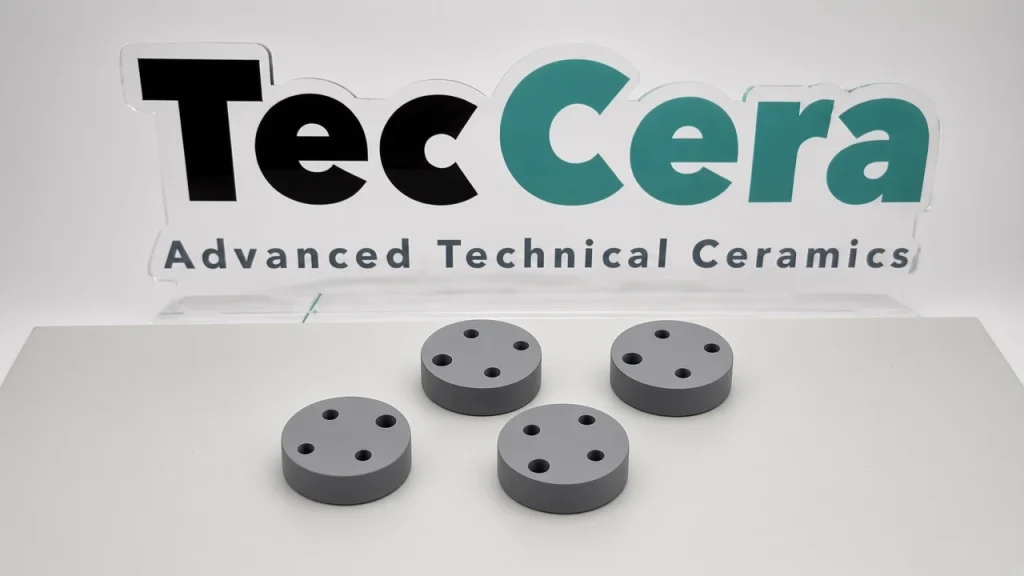
Silicon Nitride Ceramics
Silicon Nitride (Si₃N₄) Ceramic Plates
Custom silicon nitride ceramic plates offering high strength, fracture toughness, wear resistance, low thermal expansion, and excellent thermal-shock resistance for demanding industrial applications.
Detailed Product Information
Typical Material Properties
|
Property |
Typical Value |
|
Density |
3.20–3.25 g/cm³ |
|
Upper Operating Range in an Oxidizing Atmosphere |
Up to 1200–1300°C, grade- and application-dependent |
|
Flexural Strength at Room Temperature |
800–1000 MPa |
|
Compressive Strength |
3000–3500 MPa |
|
Fracture Toughness |
6–8 MPa·m¹/² |
|
Thermal Conductivity at 25°C |
25–40 W/(m·K) |
|
Coefficient of Thermal Expansion, 25–1000°C |
3.0–3.5 × 10⁻⁶/K |
|
Typical Thermal-Shock Resistance, ΔT |
500–800 K, test-dependent |
|
Surface Finish |
As-fired, ground, lapped, or polished |
|
Dimensions and Tolerances |
Customized according to drawing |
The values shown are representative rather than guaranteed specifications. Actual properties depend on the silicon nitride grade, additives, manufacturing process, component geometry, operating atmosphere, and test method.
Silicon Nitride (Si₃N₄) Ceramic Plates
TecCera supplies precision silicon nitride ceramic plates for demanding mechanical, thermal, semiconductor-equipment, and industrial applications. Silicon nitride is a high-performance non-oxide engineering ceramic offering an excellent combination of strength, fracture toughness, wear resistance, low thermal expansion, and thermal-shock resistance.
Custom dimensions, thicknesses, holes, slots, profiles, tolerances, and surface finishes are available according to customer drawings. The appropriate silicon nitride grade should be selected according to the required mechanical performance, thermal conductivity, operating atmosphere, and service temperature.
Key Features
- High flexural strength and fracture toughness
- Excellent resistance to thermal shock
- Low coefficient of thermal expansion
- Good strength retention at elevated temperatures
- High hardness and resistance to abrasive wear
- Good chemical stability in many industrial environments
- Lower density than many engineering metals
- Precision grinding, lapping, and polishing available
- Custom holes, slots, steps, and profiles available
Typical Applications
Mechanical and Wear Components
- Wear-resistant plates and liners
- Guide and positioning plates
- Sliding and sealing components
- Structural support plates
- Precision equipment fixtures
High-Temperature Equipment
- Furnace support plates
- Thermal-processing fixtures
- Heating-system components
- Components exposed to rapid temperature changes
Semiconductor Equipment
- Wafer-handling fixtures
- Probe-card guide plates
- Positioning and support components
- Thermally stable precision parts
Power Electronics
Specialized high-thermal-conductivity silicon nitride substrates can be used in IGBT, MOSFET, EV inverter, and other power-module applications. Such substrates require separately controlled thermal conductivity, dielectric properties, thickness, surface quality, and metallization compatibility.
Generic structural silicon nitride plates should not automatically be specified as power-electronics substrates.
Related Silicon Nitride Products
- Silicon nitride ceramic tubes
- Silicon nitride substrates
- Bearing balls and rollers
- Shafts and plungers
- Nozzles and valve components
- Custom structural ceramic parts
Frequently Asked Questions
1. How does silicon nitride compare with alumina in thermal-shock resistance?
Silicon nitride generally offers better thermal-shock resistance than alumina because of its lower thermal expansion and higher fracture toughness.
Actual performance cannot be represented by one universal ΔT value. It depends on material grade, plate thickness, geometry, surface condition, heating rate, cooling medium, and test method.
2. What is the maximum service temperature of a silicon nitride plate?
The maximum allowable temperature depends on the material grade, mechanical load, atmosphere, and required service life.
An upper operating range of approximately 1200–1300°C may be achievable for selected grades and conditions. Continuous-use capability must be confirmed using the applicable material datasheet and actual operating requirements.
3. Is silicon nitride suitable for corrosive environments?
Silicon nitride provides good resistance to many industrial chemicals, gases, and wear conditions. However, it is not universally resistant to all acids, alkalis, molten salts, or molten metals.
Compatibility must be evaluated for hydrofluoric acid, concentrated alkalis, reactive metals, molten salts, and high-temperature corrosive media.
4. Can silicon nitride ceramic plates be customized?
Yes. Available customization includes:
- Length, width, and thickness
- Holes, slots, steps, and curved profiles
- Dimensional and geometric tolerances
- Precision grinding and lapping
- Polished surface finishes
- Material grades selected for mechanical or thermal requirements
Please provide a technical drawing, operating temperature, atmosphere, mechanical load, surface-finish requirement, and required quantity for technical review and quotation.
Contact TecCera for custom silicon nitride ceramic plates, material selection, samples, and quotation.